
We often hear people talking about the conservation of natural resources as a way to protect the environment and, ultimately, the human race.
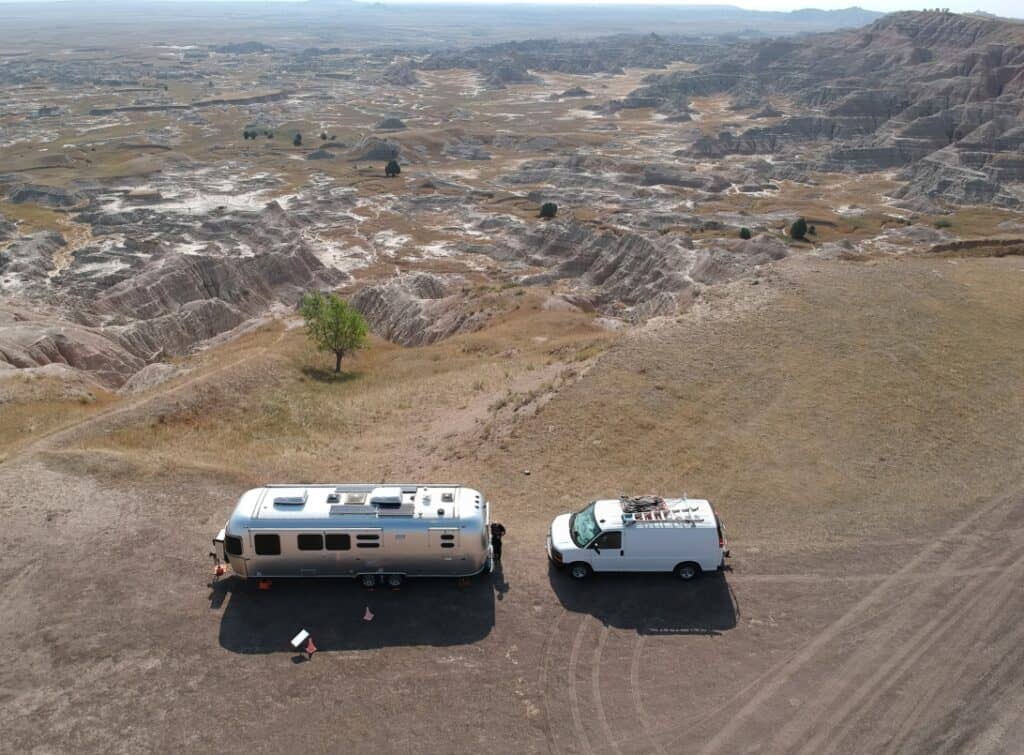
We spent 9 months on the road last year living and working in our Airstream trailer. That was followed by 3 months in our sticks-and-bricks. Now that we’re back in our Airstream, I realize how things we have to do in our RV are things we should be doing when we’re at our house.
It breaks down into a few major categories based on the resources RVers must consider daily, especially if boondocking. Those are water, electricity, and space.
Water conservation

RVers have to think about water usage constantly. If they are boondocking, they have to know how much water they have on board in their freshwater tanks. Plus, they have to think about how they use it. And if they’re hooked up to water in a campground, they are still thinking about how much they use. That’s because it’s going into their wastewater tanks.
It makes us use things like foaming dish soap that cleans dishes with less water. And it’s why we often take Navy showers. That’s where you get wet, turn off the water while washing, then turn the water on again to rinse off.
Taking a long, hot shower in our sticks-n-bricks is a nice treat. But imagine how much water you could save if you took Navy showers in houses?
Studies have shown that the average shower of just 8 minutes uses up 17 gallons of water. To put that in perspective, that would mean using up more than a third of our fresh water tank in the Airstream! And it would use up more than 40 percent of our gray tank capacity.
So the next time you shower, consider turning off the water while soaping up. You will save a ton of water. Plus, you’ll probably find that your soap lathers up and stays lathered up a lot longer. That’s because the shower spray is not instantly diluting it.
If you’re not ready to jump to Navy showers, at least turn the water off while washing your hands. Again, get them wet, turn off the water, lather your soap, then turn the water on to rinse. The same goes for brushing your teeth – except you’re lathering up your mouth instead of your hands, and hopefully with a different type of soap!
Electric conservation

RVers must always think about where the power for their rigs and appliances is coming from. Most RVs are based on a rechargeable 12-volt system. That means we are depleting batteries with every amp we draw.
Those batteries will eventually be depleted unless we recharge them by plugging them into an electrical outlet or finding the sun to power our solar panels.
So, we often keep our lighting to a minimum at night. That means turning off lights in areas of the rig we aren’t in at the moment. And making sure our outside lights are off unless we are outside and need them to see something.
I’m constantly turning off the lights at our sticks-n-bricks when I find them left on. I remind Jessi that we must pay for every ounce of energy those bulbs burn. But it’s also annoying that we’re burning through so much electricity in this country. Too many people aren’t thinking about where it’s coming from.
There’s a big push to electrify everything as if electricity is a power source. But it’s not. Electricity is the result of other power sources creating it. Maybe that’s oil, coal, solar, or wind. However, creating electricity requires some form of natural resource. So stop using so much of it if you want to conserve those natural resources.
And, please(!) turn off all those outside lights at night. They are screwing up any shot of seeing dark skies in so many areas. We have a neighbor in Michigan who has turned their front yard into a prison yard based on the amount of and the brightness of lights they burn all night long.
Space conservation

We live many months at a time in a 30-foot trailer with limited storage space and overflow storage in our cargo van. So, you might think we have whittled things down to the bare minimum. But you’d be wrong. We still have too much stuff.
And if you multiply the space we have on the road by about 8, you’ll have the square footage of our house. Imagine how much extra stuff we have stashed there!
Space is at a premium in an RV, even in rigs much larger than ours. That’s because, at some point, weight also becomes an issue. Imagine telling yourself you must put everything in your house in only one room. Even if it’s the largest room in your home, you would quickly find that you have to pare things down to make the space liveable.
As RVers, we understand that we can’t buy things “just to have them.” Our general rule of thumb is that things need to have at least two uses, if possible. And, if something new has to come in, we try to find space for it by moving something else out. While at the sticks-n-bricks this past fall, I had to empty large areas of the Airstream due to warranty work. That was a blessing in disguise. I found things on board that we had not used, and I left behind this time. The next step will be to get rid of them entirely.
Our standard answer in America seems to be that we should buy and keep everything. If we run out of room, build a bigger house. Or rent a storage space. Think about it: junk not important enough to keep readily available in your home is now stored offsite. And you are paying someone to keep it for you!
Live like an RVer
I challenge everyone to try living like an RVer for one month.
Think about how much water you’re using. Look at the lights you have on and whether you need all of them burning at once. And when you go to buy something, don’t think just about how you’re going to use it, but also how you’re going to store it.
You’ll be surprised by how much you lowered your water and electric bills at the end of the month. And you might have a bit more floor space to live in. Plus, if you’ve ever considered going on the road for long periods, shrinking your available space and resources while at your house is a great way to prepare for living in an RV.
1 thought on “RVers could teach homeowners a lot about conservation”