
Estimated reading time: 8 minutes
In southeast Texas, along the San Antonio River, lies a small unassuming town that once played a prominent role in both Mexican and Texan history. It is well-known for a few significant historical events, including Spanish colonization, the birthplace of a famous Mexican general, and a Texas Revolution massacre.
We produced a video about our visit to this area for our YouTube channel, but there is so much to share, we thought a blog post would be in order, as well.
Mission Nuestra Señora del Espíritu Santo de Zuñiga
The Mission Nuestra Señora del Espíritu Santo de Zuñiga, commonly known as the Mission Espíritu Santo, is the key feature at what is today Goliad State Park. One of the many Spanish missions established in what is now southeast Texas, Mission Espiritu Santo was built in this location in 1749 as part of Spain’s efforts to colonize the area. (Sidenote: The famous Alamo originally started as one such Spanish mission.)
Colonization was politically and economically advantageous for Spain. Missions were designed to convert local native populations to Catholicism, serve as agricultural communities, and deter the French from gaining a foothold in the region. In addition to “saving souls”, the missions were a way to create a supply of native labor for tending crops and cattle.

While the natives who lived in the region weren’t really interested in becoming Catholic, they often chose to try life at the mission because it provided food, shelter and protection from raids from other native tribes.
Those who lived at Mission Espíritu Santo became adept horse riders and ranchers, and the mission became the one of the first large cattle ranches in the region, with the herd reaching around 40,000 at its peak in 1788. However, disease, desertion, raids, and war led to a decline in the native population and by the early 1800s the mission was abandoned.
The mission buildings sat empty, falling apart, and being pilfered until the 1930s when the Texas Parks and Wildlife Department took control of the property. They brought in the Civilian Conservation Corps to conserve and restore the mission. The CCC boys learned woodworking and stone masonry skills and rebuilt portions of the mission, including the chapel, and some of the outbuildings. The perimeter rock wall is one of the only original features left, although today it is much shorter than the original 8-foot-high hand-laid stone wall due to natural erosion and rock looting by locals.
A few miles away, Goliad State Park also oversees the ruins of the 1750s Mission Nuestra Señora del Rosario, another one of the Spanish missions. Today, all that is left are a few crumbling stone walls, but if you visit you can get an idea of the size and layout of the mission.
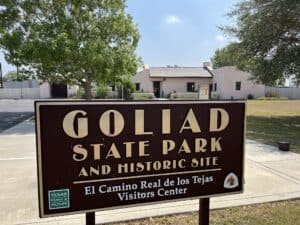
In addition, make sure you visit the Goliad State Park Visitors Center. It’s located in a unique house that is full of varying styles of architecture. The house was actually a training ground for the CCC boys who were learning the construction methods of the 1750s. That’s why there are numerous styles of doors, wrought iron curtain rods, mismatched windows, a staircase carved out of a giant tree, and more. It is truly a sight to see!
Presidio La Bahía – “Remember Goliad!”
Directly across the San Antonio river from Mission Espíritu Santo is the Presidio La Bahía. A presidio is a Spanish military fort, usually built in conjunction with a mission to protect and defend the mission and the frontier.

After the decline of the Mission Espíritu Santo, this particular presidio ultimately played a major role in the Texas Revolution with both Texan and Mexican troops vying for its strategic position.
You likely have heard about the rallying cry “Remember the Alamo.” What you might not recall is the second part of that cry that was just as important to the success of the Texas Revolution, but today is often forgotten: “Remember Goliad”.
A few days after the fall of the Alamo in 1836, orders came for Texas Colonel James Fannin and his 350 men to abandon their post at the fort and retreat. Unfortunately, a much larger Mexican army ambushed and surrounded Fannin’s troops only 10 miles into their journey. After holding off the Mexicans for 2 days, Fannin surrendered his troops under the agreement they become prisoners of war and were marched back to the presidio.
Unfortunately, General Santa Anna, the merciless Mexican President and leader of the Mexican army, considered them pirates, not prisoners, and ordered a brutal execution of all the men. On Palm Sunday, March 27, 1836, the Mexican army marched more than 300 men outside the presidio’s walls and massacred them. (Many of the stories about what happened came from the few survivors from Fannin’s group whose lives were spared for various reasons.)
This heinous act led to the rallying cry of the Texans during the Battle of San Jacinto: “Remember the Alamo! Remember Goliad!” San Jacinto was the final battle of the Texas Revolution in which the Texans defeated Santa Anna and gained their independence.
Today, you can tour the reconstructed presidio and visit the Fannin Memorial Monument, which marks the common burial site of Col. Fannin and his men. Ten miles away you also can visit the location where Fannin and his men attempted to hold off the Mexicans and ultimately surrendered at the Battle of Coleto Creek. A small museum and monument mark the location.
General Zaragoza and Cinco de Mayo
Goliad also is connected to a third piece of Mexican history. Ever wondered why we celebrate Cinco de Mayo? It’s not just a day for tacos and margaritas, and it’s also not Mexico’s Independence Day. May 5th was the day that Mexican General Ignacio Zaragoza and his troops defeated the French at the Battle of Puebla in 1862, a major event in the Mexican War.
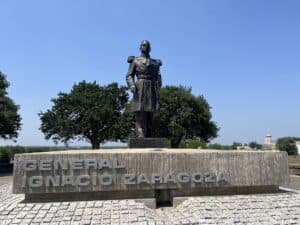
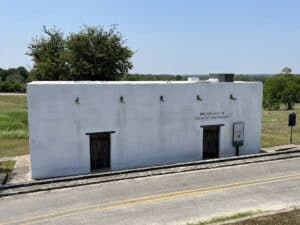
Goliad happens to be the birthplace of Zaragoza. He was born in 1829 in a small house that was part of the village that cropped up around the outside of the presidio walls. A small museum located on the site tells about his life, the Mexican War, and the history of Cinco de Mayo. A 10-ft tall statue of General Zaragoza is located nearby. The town of Goliad takes great pride in this piece of history, annually holding a weekend-long Cinco de Mayo celebration in his honor.
Speaking of the town, from the state park you can take the Angel of Goliad walking and biking trail that stretches 2.5 miles from the Angel of Goliad statue near the presidio to downtown Goliad. Goliad’s town square features the Goliad County Courthouse, restored to its original 1894 appearance. There’s also a small handful of stores and cafes.
Goliad State Park Campground
The Goliad State Park also has a campground for those who wish to stay a night or more. The state park sits along the San Antonio River, but it’s not very accessible due to the high banks. There are a few spots where you can put in a kayak or go fishing if you have your own equipment.
There are 3 main campground sections:
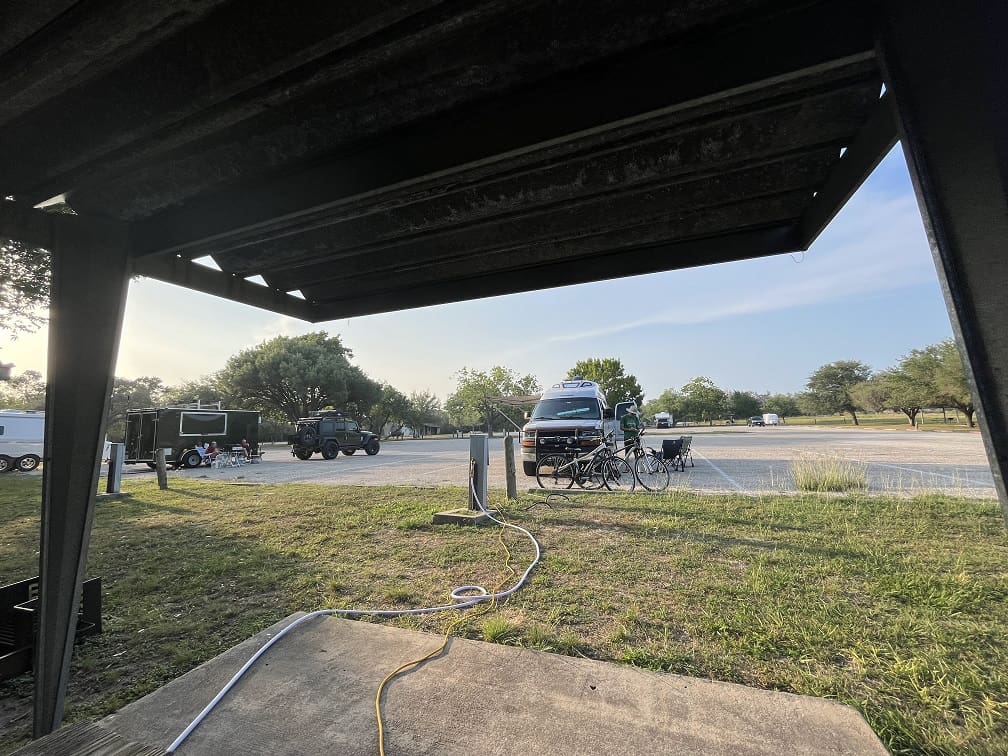
- The first is near the main entrance and offers pull through, full hookup sites. Five screened cabins are also available in this section for rent. A modern bath/shower house also is onsite.
- The second area is down near the river and is for tent camping only. There is no electricity but there are water spigots. No modern toilets or showers are in this area.
- The third area is almost a mile drive into the campground, but if you have your bikes, or want to walk, it’s quicker to hop on the Angel of Goliad trail that cuts up to the front gate. This section had electric and water for both RVs and tents. It’s a bit of an odd campground. Each campsite was essentially two parking spaces in a parking lot that was repainted to accommodate RVs. Each site has a bit of grass behind it with a covered picnic table, grill and fire pit. Maybe not what you think of as a campground, but it was quiet, dark and level. The bathroom and shower house in this area was definitely old and only had one shower stall per gender.
If you have any interest in learning about the past, Goliad is the place to do so — it’s a small town with a huge role in Texas history!
Not all the soldiers were killed in the massacre. My Great great grandfather, Dillard Cooper, was one a handful of survivors.
You are correct, and I have updated the post to make that clearer as it may have been confusing before. Thanks for pointing this out. And that’s amazing to hear about your family history. Thank you for sharing, and feel free to share more. We are big history buffs and are always on the lookout for more information on these types of places and events. -Ari
My grandma was born in Goliad in 1909..Enriqueta Villarreal Gracia married to Cruz Bazan from Mier Mexico..
Wow, thank you for sharing your family history. We’re always interested in hearing these stories!